
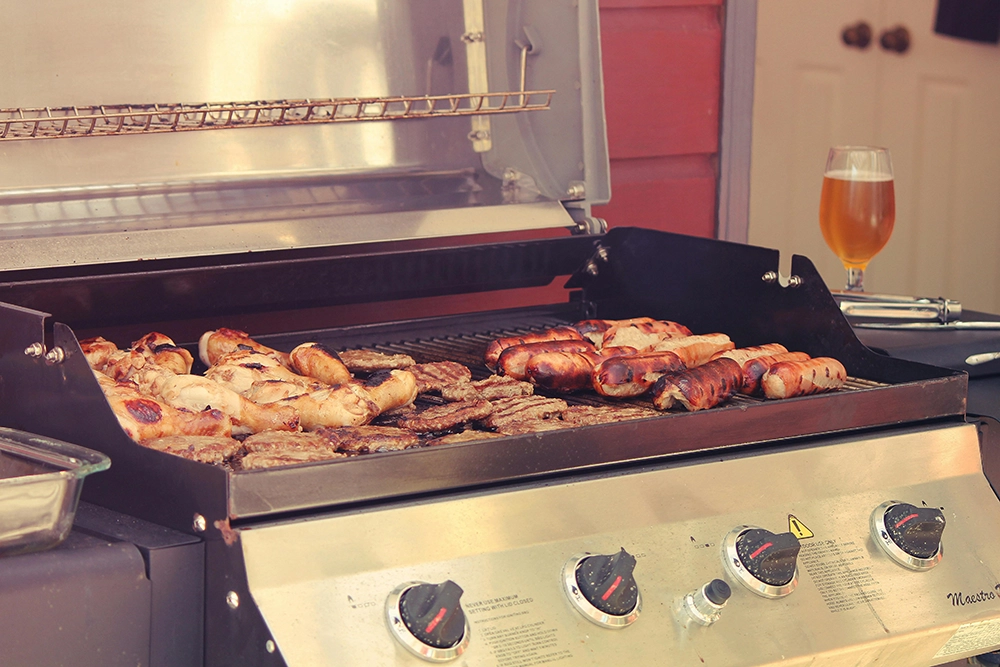
Cooking over fire doesn’t begin when the food touches the grill, it begins earlier, in the small, almost unnoticed decisions that shape everything that follows—the way you arrange the coals, the way you let the flame settle instead of forcing it, the way you wait just long enough to feel that the heat has found its balance. There’s something instinctive about that moment, something that doesn’t come from instructions but from repetition, from having stood there before and knowing that rushing it never leads anywhere good. Fire doesn’t respond well to impatience. It never really has. It asks for attention, not control, and the sooner you understand that, the easier everything else becomes.
There’s a particular kind of focus that comes with grilling that’s hard to replicate anywhere else. You don’t step away from it the same way you might with something on the stove, you don’t rely on settings or timers in quite the same way. You stay close, not out of necessity, but because you want to. The fire changes constantly, even when it looks steady, and you begin to read it without thinking too much about it—the way the heat moves across the surface, the way certain spots cook faster than others, the way the flame reacts when something hits it. It becomes less about managing and more about responding, less about directing and more about paying attention.
When food finally meets the grill, everything becomes immediate in a way that feels almost physical. The sound arrives first, sharp and unmistakable, followed by that first wave of smoke that carries more information than you realize at first—the beginning of flavor, the start of transformation. There’s no slow build into it, no gentle introduction. It happens all at once, and from that moment on, you’re involved in it completely. You turn, you shift, you adjust, not because you’re following a set of rules, but because the food itself tells you what it needs. It shows you, if you’re willing to look closely enough.
Grilling, in that sense, is direct and honest. It doesn’t hide anything. What you do is visible almost immediately, and the result is tied closely to how present you are in those moments. High heat, quick changes, that balance between a surface that carries depth and an interior that remains exactly what it should be. It’s not about pushing the process forward, it’s about catching it at the right time, letting it reach that point where everything feels aligned without going too far. When it works, it doesn’t feel like you controlled it, it feels like you moved with it.
Barbecue shifts that rhythm entirely, stretching it out into something slower, something that doesn’t reveal itself right away. The heat lowers, the distance increases, and suddenly time becomes the main ingredient. You’re no longer reacting to quick changes, you’re allowing something to develop gradually, almost quietly. Smoke settles in, not aggressively, but steadily, building layers that don’t announce themselves immediately. The surface stays calm, the structure remains intact, but underneath, everything is changing. It’s a different kind of patience, one that asks you to trust what’s happening even when you can’t fully see it yet.
There’s something grounding about that kind of cooking, about knowing that no amount of rushing will get you to the same result. You can’t force it, you can’t shortcut it, and eventually, you stop wanting to. You begin to understand that the time it takes isn’t separate from the outcome—it’s part of it. The flavor, the texture, the way everything comes together, all of it is built slowly, piece by piece, in a way that only works when you let it happen at its own pace.
But what stays with you most isn’t just the technique, it’s everything around it. Cooking over fire rarely exists on its own. It happens in spaces that feel open, where the boundaries between preparing food and being present start to blur. You’re not plating dishes in a sequence, you’re sharing things as they’re ready. Something comes off the grill, it gets passed around, someone reaches for it without asking, another piece follows a few minutes later. The table builds itself gradually, not through structure, but through movement.
And in that movement, something shifts.
You stop thinking about the meal as something with a beginning and an end, and it starts to feel more like a moment you’re inside of. Conversations stretch without interruption, pauses don’t feel empty, they feel part of the rhythm. You’re not waiting for everything to be ready, you’re already eating, already sharing, already there.
Travel makes you realize how universal that feeling is. The ingredients change, the methods shift slightly, the flavors move in different directions depending on where you are, but the relationship to fire remains consistent. It’s always about transformation, always about time, always about understanding that you’re working with something that has its own pace, its own logic. You don’t impose on it, you meet it where it is.
And once you’ve spent enough time cooking that way, it changes how you think about food entirely. You become less interested in controlling every detail and more interested in understanding how things come together on their own. You learn to trust the process, to recognize that not everything needs to be forced into precision to turn out well. Some of the best results come from paying attention rather than trying to manage every step.
Because fire, in its own way, teaches you something that stays with you long after the meal is over. That patience isn’t a delay, it’s part of the outcome. That not everything needs to be perfectly controlled to be done well. And that when you give something the right balance of heat, time, and space, it will find its way to exactly where it needs to be, without you having to push it there.