
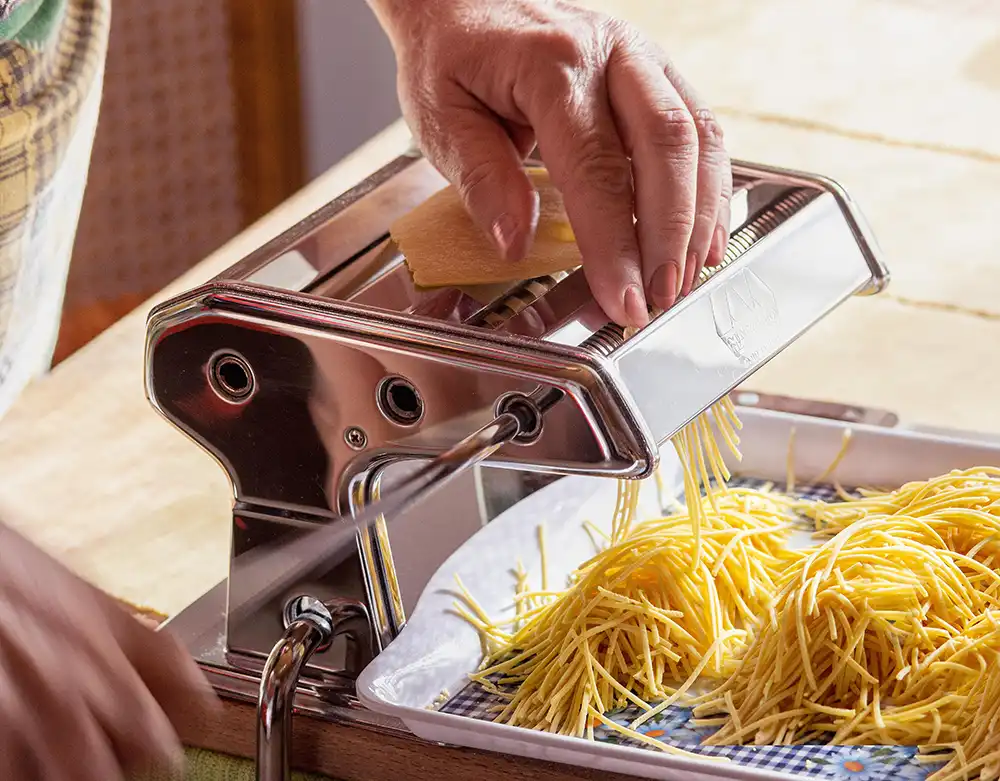
Pasta doesn’t really begin with ingredients, at least not in the way you expect. It begins with a feeling you recognize before you understand it, something that happens the moment your hands meet the dough and you realize it’s not going to behave perfectly right away. It’s a little rough at first, slightly uneven, not yet willing to come together cleanly, and for a moment it feels like you’re just moving flour around without much direction. But then something shifts, almost without warning. The dough tightens, smooths out, starts to push back just enough that you feel it holding itself together. It’s subtle, but it’s unmistakable. That’s the moment you know you’re not just mixing anymore—you’re building something.
There’s a rhythm that takes over once you’re in it, and it doesn’t feel like something you’re controlling so much as something you’re following. You work the dough, then you leave it alone, and in that time it changes in ways you don’t see happening. It relaxes, settles, becomes easier to shape, easier to stretch without tearing. When you come back to it, it feels different in your hands, more cooperative, more complete. And when you start rolling it out, when it begins to thin and lengthen, there’s a point where it almost disappears into itself, delicate but still strong, like it’s reached a balance it was always moving toward.
From there, everything opens up, but not in an overwhelming way. It’s quiet, controlled, almost intuitive. You cut it, shape it, fold it, and each movement feels like a continuation of the last rather than a new step. What’s interesting is how much meaning lives in those small choices. A long strand moves differently than a short cut. A hollow shape carries weight in a way a flat one doesn’t. Even the surface—smooth or slightly textured—changes how everything comes together once it’s finished. None of these decisions feel dramatic when you’re making them, but they define the entire experience once the dish is complete.
Cooking it is where everything becomes immediate again, but not rushed. There’s a moment when pasta hits the water that feels almost like a release, like everything you’ve built is now out of your hands, but only partly. You’re still watching, still paying attention, but in a different way. It’s not about shaping anymore, it’s about timing, about catching that exact point where the texture holds just enough resistance without becoming firm. You don’t really measure it. You feel it, you taste it, you recognize it from having been there before. It’s one of those things that becomes clearer the more you stop trying to force it into precision.
And then, almost without thinking, it moves into something else entirely, because pasta on its own is never really the point. It’s what it carries, what it connects to, what it becomes part of that gives it meaning. Sauce, if you even want to call it that, doesn’t sit on top of pasta the way people often imagine. It moves with it, wraps into it, settles into the spaces that each shape creates. When it’s right, it doesn’t feel like two separate things coming together. It feels like one idea expressed in two different ways.
There’s something about that balance that stays with you, especially when it’s done simply. A few ingredients, handled with care, brought together at the right moment. Nothing forced, nothing overworked. You don’t need complexity for it to feel complete. In fact, the more you remove, the more clearly everything else comes through. You start to notice texture more, timing more, the way one element supports another without overpowering it.
And the more time you spend with it, the more you realize how universal that feeling is. You find it in different places, expressed in different ways, but always built on the same foundation. Dough, shaped and transformed, paired with something that completes it. The flavors change, the techniques shift, but the structure remains familiar. It’s one of those things that connects across places without needing to be identical.
What changes, though, is the way you experience it. In some places, pasta feels almost weightless, something you move through gently, without interruption. In others, it leans into something deeper, more grounded, something that asks you to slow down just a little more. But in both cases, there’s a sense that it isn’t meant to be rushed. You sit with it. You stay with it longer than you planned to. And without really noticing, the pace of everything around you adjusts to match it.
That’s what makes it different.
It’s not just the food, it’s the way it changes the moment.
You’re not eating to move on to something else. You’re not filling time. You’re settling into it, letting it stretch, letting it hold you there a little longer than you expected. And in that space, everything feels more connected—not just the dish itself, but the experience around it.
Because pasta, when it’s done the way it should be, doesn’t feel constructed. It doesn’t feel like a series of steps executed correctly. It feels like something that came together naturally, something that found its balance without being forced into it. And once you’ve experienced that, even once, it changes how you approach it every time after.
You stop trying to control every detail.
You start paying attention instead.
And somewhere in that shift, without really realizing when it happened, you begin to understand that what you’re making isn’t just a dish—it’s a rhythm, one that’s been there all along, waiting for you to fall into it.
Pasta e Fagioli,
Spaghetti with Charred Vegetables and Gremolata,
Cacio e Pepe,
Ravioli di Zucca (Pumpkin Ravioli), and
Seafood Linguine with Spicy Tomato Sauce.