
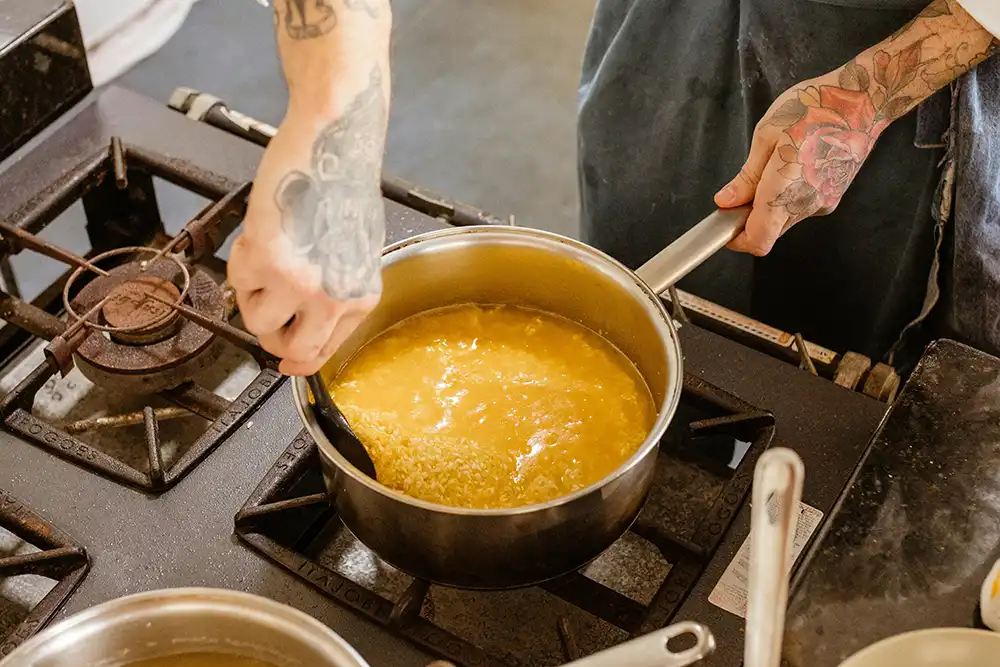
Steam lifts slowly from the pot, carrying with it a warmth that feels steady rather than urgent, the kind that asks you to stay close without demanding your full attention all at once. There’s a quiet rhythm in the way rice cooks, something almost repetitive at first—liquid added, absorbed, stirred, then added again—but the longer you remain with it, the more you realize that nothing about it is actually repetitive. Each movement changes something. Each moment shifts the texture slightly, bringing it closer to that point where everything begins to hold together without losing its softness. It’s not dramatic, not something you can point to immediately, but it builds in a way that becomes undeniable if you’re paying attention.
Rice has a way of revealing itself slowly. At first, it feels simple, almost too simple to require much thought. A grain, a pot, some liquid. But as it cooks, it becomes clear that what matters isn’t what you start with, it’s how you stay with it. There’s a difference between letting it cook and actually cooking it, and that difference lives in attention. Not constant movement, not overworking, but a presence that allows you to recognize when something shifts. You begin to notice how the grains respond, how they soften without losing their shape, how the liquid thickens without becoming heavy. It’s a process that doesn’t reward distraction, but it also doesn’t ask for intensity. It asks for consistency.
Risotto lives entirely inside that space. It’s less about technique in the traditional sense and more about rhythm, about understanding that the structure of the dish is built gradually rather than assembled at the end. You add liquid, but not all at once. You stir, but not aggressively. You allow the starch to release, but only as much as it needs to. And somewhere along the way, without a clear signal, everything begins to come together. The grains stop feeling separate. The liquid stops feeling external. What you’re left with is something that moves as one, something that settles gently rather than holding firm, something that feels complete without being fixed in place.
That’s the moment you’re always moving toward, even if you don’t realize it at first.
It doesn’t arrive with a clear marker. You recognize it through feel, through movement, through the way the spoon passes through it and leaves just enough of a trace before everything settles back into itself. It’s a balance that exists between structure and fluidity, between something you can plate and something that still feels alive. And once you’ve seen it happen, once you’ve felt that shift, it becomes easier to return to it again, not by following steps, but by understanding what you’re looking for.
Rice, more broadly, carries that same sense of quiet transformation across different ways of cooking it. In some moments, it’s light and separate, each grain holding its place, carrying flavor without absorbing too much of it. In others, it leans toward something more unified, something that brings everything together into a single expression. And then there are times where it softens even further, becoming something closer to comfort than structure, something that doesn’t need definition to feel complete. The technique changes, the intention shifts, but the core remains the same. It’s always about absorption, about how something small takes on what surrounds it and becomes something more.
There’s a patience built into that process that doesn’t feel forced. You’re not waiting in the sense of doing nothing, you’re waiting in the sense of allowing something to develop without interrupting it. You add, you adjust, you observe, but you don’t rush forward. You let the rice move at its own pace, and in doing so, you begin to understand how much control actually comes from restraint. It’s not about doing more. It’s about knowing when to stop.
That understanding changes the way the dish feels once it reaches the table. Rice doesn’t dominate, it doesn’t try to stand above everything else, but it anchors the entire experience. It gives weight without heaviness, presence without intensity. It invites you to stay with it, to move through the meal at a pace that feels natural rather than imposed. There’s no urgency in it, no pressure to move on quickly. It settles into the table the same way it settles in the pot—gradually, confidently, without needing to prove anything.
Travel makes that even clearer. You begin to notice how rice adapts to place, how it reflects the environment it comes from, the flavors that surround it, the traditions that shape it. But no matter where you are, the relationship remains familiar. It’s always about time, always about liquid, always about allowing something simple to become complete through attention. You might not recognize every ingredient, but you recognize the process. You recognize the feeling of it coming together.
And once you understand that, rice stops feeling like a supporting element.
It becomes something you build around.
Because what it offers isn’t just texture or flavor, but a way of cooking that stays with you. It teaches you to notice small changes, to trust gradual progress, to understand that not everything reveals itself immediately. It reminds you that some of the most complete dishes are the ones that don’t try to do too much, the ones that focus on doing one thing well and allowing everything else to fall into place around it.
And when it’s done right, when everything aligns without effort, it doesn’t feel like something you constructed step by step.
It feels like something that arrived exactly as it was meant to.
Seafood Risotto with Saffron,
Risotto al Nero di Seppia (Squid Ink Risotto),
Risotto ai Funghi Porcini,
Risotto con Salsiccia e Gorgonzola, and
Fideuà with Shrimp, Squid, and Seafood.